


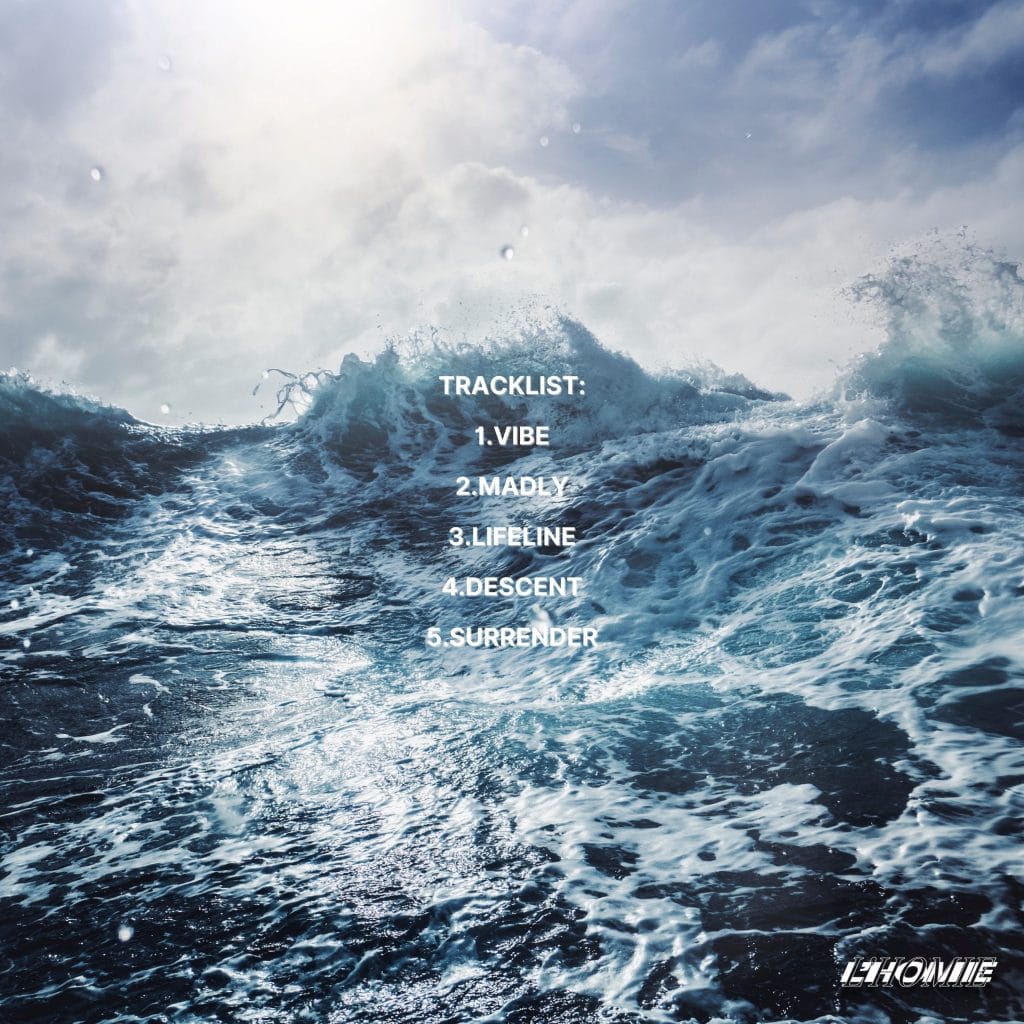
Hong Kong-born, Los Angeles-based producer L’homie returns with LIFELINE, a five-track EP landing February 27 via MP3 Records, and this one carries weight beyond a standard release cycle. It marks his first major body of work in over two years, and you can hear that time in the structure, in the restraint, and in the decisions.
The EP moves through UK garage, drum and bass, dubstep, and hybrid territory, yet it never feels scattered because the framework is intentional. Four genres, four pillars, one through-line focused on identity, purpose, and the tension between clarity and chaos.
Support The EP on Bandcamp here
What stood out to me in this conversation is how directly the record’s mindset maps onto the music itself.
L’homie talks about balancing a full-time job with studio time, about the mental noise that creeps in when you start thinking about success instead of connection, and about setting constraints so the work actually gets finished. That discipline is audible across LIFELINE. The title track locks into jump-up drum and bass momentum with precision; “Descent” leans into 140 bpm without overcomplicating the arrangement; and “Surrender” closes the arc by merging rhythmic influences in a way that feels resolved rather than forced.
This is not a project built on chasing trends or stacking singles for algorithm traction. It is structured, deliberate, and thematically consistent, and that is increasingly rare in the bass space right now. With vinyl available for pre-order and the EP officially out through MP3 Records, LIFELINE reads like a recalibration. The interview below makes that clear.
Interview With L’homie
What distractions have the biggest impact on your ability to make your best work?
My biggest distraction currently is trying to balance a job with making music. At 35, I’m not in the same place I was in my 20s where I could solely focus on the art. Now I’m constantly trying to keep both plates spinning… and sometimes, it’s exhausting. The mental space needed to create requires 100% of my focus.
The other distraction, the one that’s harder to admit, is that chip on my shoulder. That voice telling me I need to prove I’m not a failure. It makes me second-guess everything. Instead of just creating, I’m thinking about how it’ll be received, whether it’s “successful enough,” and if it’ll finally show the doubters that they’re wrong. That’s the real killer. Because when I’m making my best work, like with LIFELINE, it’s when I stop chasing validation and start chasing a larger purpose. My work gets better when I remember music is supposed to be a bridge between people, not a trophy to prove something.
The opportunities are rare now. And when they do come, I’m grateful. But the distraction is always there – am I doing this for the right reasons? Am I making art or am I making a case for myself?
How do you protect your focus when everything around you is pulling for your attention?
Honestly? I don’t always protect it well. That’s the truth. Between work and music and life, focus feels like this rare thing I have to fight for.
But when I do find it, it’s usually in those quiet hours. Early mornings in my home studio where it’s just me and the music. Long walks where I can let my thoughts get loud without a thousand other things competing for space. Those in-between moments when I’m not actively making music but just sitting with it, letting questions surface without trying to immediately answer them.
I’ve learned I have to be intentional about creating those spaces. Because the world isn’t going to give them to me. The job won’t. The distractions won’t magically disappear. The chip on my shoulder that tells me I need to constantly prove something – that doesn’t just go away.
What helps is remembering why I started doing this in the first place. Not for validation, not to prove doubters wrong. But because music is how I make sense of things I don’t have words for. It’s that bridge between people. When I reconnect with that, I remember I’m chasing something that is greater than me.
With LIFELINE, I had to stop hiding behind technical skill and genre rules and just be honest. That required focus. Protecting that focus meant I had to say no to the part of me that wanted to play it safe, that wanted to just put out another project without real thought behind it.
Have you ever noticed a drop in quality when you let too much external input into your sessions?
Absolutely. And it’s taken me years to recognize it.
Throughout my 20s, I’d put out singles consistently without much thought to marketing or intention behind them. Just releasing for the sake of releasing. Taking in everyone’s opinions, trying to make something that would land, that would prove I wasn’t failing. And looking back, you can hear it. The work was technically solid but it lacked something deeper… It lacked me.
The quality drops when I’m making music for the wrong reasons. When I’m listening to too many voices telling me what it should sound like, what genre will do better, what the market wants. When that chip on my shoulder gets too loud and I’m creating to prove something rather than to express something.
With LIFELINE, I had to shut a lot of that out. I had to stop hiding behind technical proficiency and genre conventions. Stop thinking about what would make me look like a “successful musician” and start asking what actually needed to be said. The work demanded more from me because I couldn’t let that external noise dictate it.
The moment I let too much external input in, I lose that. The work becomes about approval instead of connection. And you can hear the difference.
What systems or boundaries help you stay locked in when it’s time to work?
Constraints, actually. That’s what helps to keep me locked in.
When I started working on LIFELINE, I gave myself boundaries – four genres, each one representing a different part of who I am. Four genres that helped shape the producer I am today. That framework became the system. Instead of having infinite options pulling me in every direction, I had guardrails. Drum & Bass, Liquid, Dubstep, and UKG. That’s it. Work within that.
It sounds limiting, but it’s actually quite the opposite. When you have too many options, you get paralyzed. You keep second-guessing, chasing whatever sounds good in the moment, never committing to anything. But when you set constraints, you force yourself to go deeper instead of wider. You have to make decisions. You have to find purpose in what you’re doing instead of just throwing things at the wall.
Now I work with purpose first. What is this piece trying to say? How does it fit into the larger story? Which of these four languages am I speaking in right now? That clarity keeps me from wandering off into every rabbit hole.
The constraints give me freedom, weirdly enough. Less choice, more focus. Less distraction, better work.
How do you keep your workflow from turning into a loop of checking, tweaking, and second-guessing?
I set deadlines and I commit to decisions, even when they scare me.
The tweaking loop happens when you don’t trust yourself. When that voice kicks in telling you it’s not good enough, that you need to prove something, that one more tweak will make it perfect. But perfect doesn’t exist. And chasing it just means you never finish anything.
With LIFELINE, I had to make a rule: once a track fits the genre constraint and says what it needs to say, it’s done. Not perfect. Done. Because if I kept going back, I’d tweak it into something safe, something that hides behind technical proficiency instead of just being honest.
I also stopped working alone on everything. My team at MP3 Records keeps me accountable. When I start spiraling, second-guessing every choice, they pull me back. Sometimes you need someone outside your head to tell you it’s finished, to remind you that the work is good enough.
What role does digital distraction (social, email, etc.) play in your creative process — and how do you manage it?
It’s brutal, honestly. Social media especially. Because as a musician trying to get opportunities that are increasingly rare, there’s just too much competition. I need it for promotion, for connecting with people, for letting everyone know that the music even exists. But it’s also the thing that pulls me out of the flow constantly.
I’ll be in the studio, finally locked in on something, and then I’ll check my phone. See how the last post did. Read comments. Scroll. And suddenly twenty minutes have gone by and I’ve lost that thread I was following. The flow’s broken.
Email’s the same. Always something needing a response. Always something pulling at my attention. And at 35, trying to balance a job and music, those notifications feel urgent even when they’re not.
What helps is treating studio time like it’s sacred. My phone goes on Do Not Disturb. No social media, no email, nothing. If I don’t protect that space, it doesn’t exist.
The hard part is after the work’s done. Because then I have to jump back in – posting, engaging, trying to market the music. There’s always this tension between making the art and selling the art.
I’m not great at managing it. But I’m learning that the work has to come first. The distractions will always be there.
What’s changed in your sessions since you started prioritizing focus more deliberately?
I’m actually in a rhythm now that doesn’t feel like I’m constantly sacrificing one thing for the other.
For a long time, it felt like work and music were at war with each other. Like I had to choose between paying bills or making music. But since I’ve been more intentional about focus, I’ve found this balance where both can exist. Work happens during work hours. Music happens in those early morning sessions. And I’m not bleeding one into the other as much anymore.
The writing process flows much better because of it. I’m not showing up to the studio stressed about everything else I should be doing. I’m not sitting at my job thinking about the track I left unfinished. When it’s time to work, I work. When it’s time to create, I create. That separation has been huge.
And honestly? The music benefits from having a life outside of it. All of my experiences, the conversations, the routine – all of that feeds back into what I’m writing. I’m not just living in the music bubble. I’m living, and then bringing that into the sessions.
The balance isn’t perfect. Some weeks are better than others. But I’m not burning out the way I used to. I’m not forcing sessions when there’s nothing there. I trust the process more. I trust that the ideas will come when they’re supposed to, and that the space I’ve created for them is enough.
That trust changes everything in the studio. I’m calmer, more present, and the work reflects that.
The post The Creative Boundaries That Defined L’homie’s LIFELINE EP appeared first on Magnetic Magazine.