



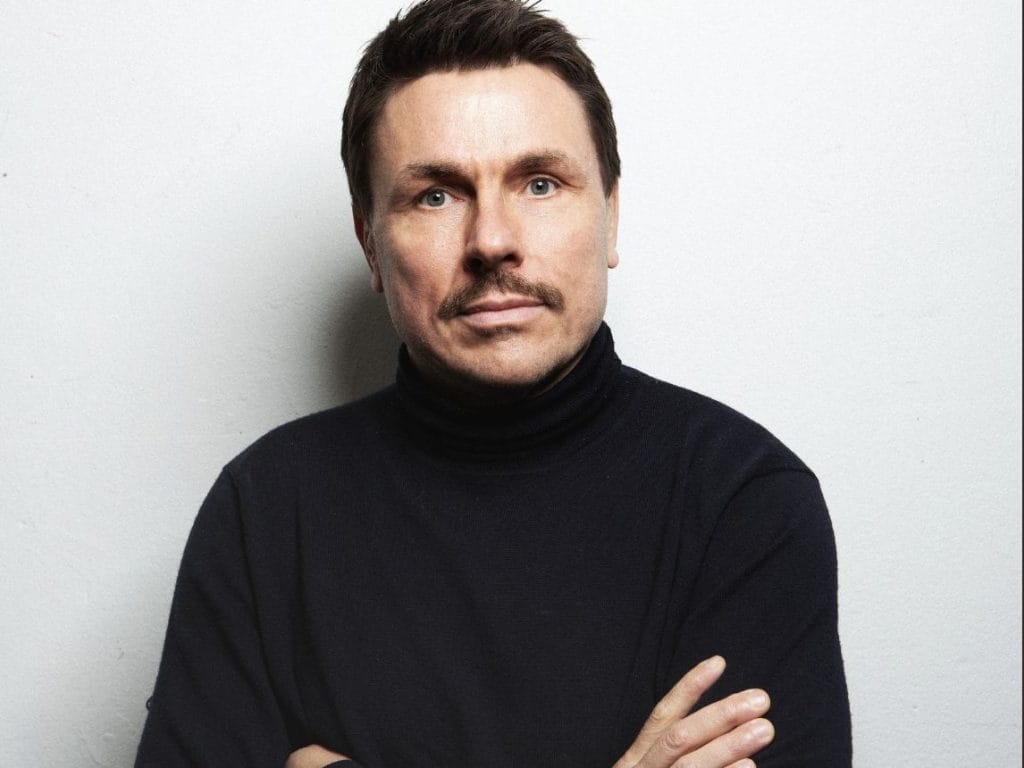
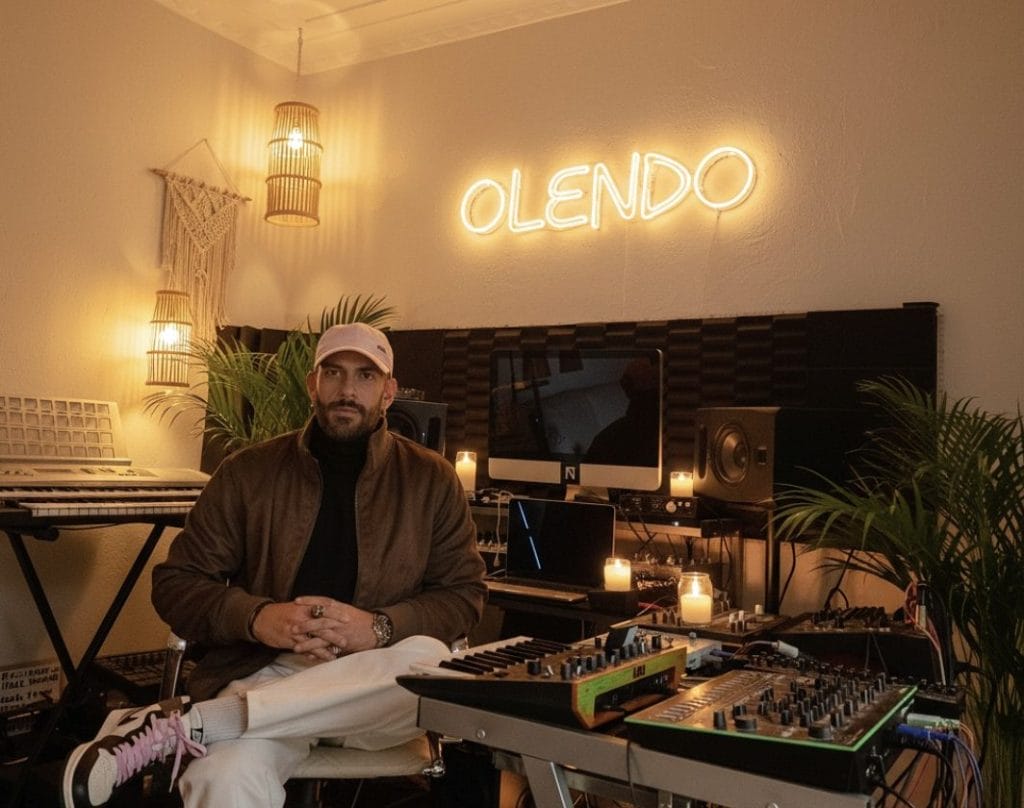
Olendo arrives on the label with the Folklore EP, a two-track release built around rhythm, organic instrumentation, and a production approach that prioritizes feel over formula. His work draws from global percussion traditions, using congas, hand-played patterns, and repeating figures that move with intention while staying grounded in club-ready structure. Rather than chasing uniform tempos or standardized drops, Olendo shapes tracks that breathe and shift, which reflects his interest in movement, trance, and the physical response of listeners rather than quick recognition in playlists.
The title track “Folklore” sets the tone with layered percussion, steady motion, and subtle changes in texture that reward long-form listening. It unfolds gradually, allowing small rhythmic details to take on meaning as the arrangement develops. “Chains” continues that direction while leaning into a tighter pulse and a darker tone, creating contrast through pattern and restraint rather than through abrupt changes. Together, the two tracks function as a focused statement, one that connects club utility with a deeper attention to rhythm and pacing.
Across the Folklore EP, Olendo keeps the production direct and human, choosing groove and timing over surface gloss and predictable arcs. His perspective comes through in the way each track resists fast payoff and instead builds trust through repetition and motion. This release reflects an artist who listens closely to how music moves bodies and holds space, and it fits naturally into a catalog that values identity, patience, and records designed to be experienced in full rather than skimmed in parts.
Interview With Olendo
Have you noticed streaming platforms nudging everything toward the same tempo, texture, or polish?
Yes, very clearly. Over time, I’ve noticed that streaming platforms seem to reward a specific sonic profile… certain tempos, familiar grooves, and a highly polished finish. It’s not something that’s enforced overtly, but more a quiet gravity that pulls music toward the centre. Tracks that sit comfortably within recognisable BPM ranges and have predictable energy arcs tend to travel further, while anything that deviates feels like it has to work harder to be heard.
The polish itself has become almost a prerequisite. Clean low-end, controlled dynamics, and mixes that translate seamlessly across earbuds, cars, and club systems are favoured. While technical quality is important, the issue arises when polish becomes aesthetic uniformity rather than clarity. You start hearing different artists, from different places and backgrounds, all arriving at remarkably similar sonic conclusions.
Tempo is another subtle area of convergence. Certain BPM ranges dominate because they’re deemed “playlist-friendly” or versatile enough to sit across multiple contexts. Music that drifts between tempos, breathes naturally, or resists grid-locked structure often feels like an outlier. That fluidity, once a strength in underground music, can now be perceived as a risk.
Texture has flattened in a similar way. Rawness, noise, and spatial irregularities are often smoothed out in favour of glossy surfaces. Saturation is controlled, reverb tails are pristine, and imperfections are edited away. While this creates consistency, it can also remove the sense of place and humanity that once made records feel alive.
What’s interesting is that this flattening doesn’t come from malice. It’s a by-product of scale. Platforms need systems to process, categorise, and recommend millions of tracks. But systems favour predictability, and predictability slowly reshapes creativity. Over time, that reshaping becomes normalized.
As a producer, you feel this pressure even if you try to resist it. You become aware, sometimes unconsciously, of what “works” in the ecosystem. The challenge is deciding when to honour that knowledge and when to deliberately ignore it in favour of feel.
For Olendo, I try to treat these pressures as something to be aware of, not obey. Understanding the landscape is important, but I don’t want the music to be a by-product of optimisation. I’d rather it feel human, contextual, and slightly unpredictable, even if that means it doesn’t always fit neatly into the system.
What kind of tracks do you think are less likely to show up in algorithm-driven playlists?
Tracks that take time are often the first to disappear. Music that unfolds slowly, builds atmosphere gradually, or delays gratification doesn’t always perform well in algorithmic environments. If a track doesn’t establish its identity quickly, it risks being skipped—and that single action can determine its future visibility.
Records that blur functional boundaries are also less likely to surface. Music that sits between listening and club contexts, or between genres, can confuse recommendation systems. If it’s not clearly “for” a specific moment… workout, party, focus, it becomes harder to place, regardless of its emotional depth.
Live recordings, raw takes, and imperfect performances struggle too. Algorithms favour consistency, and live energy is inherently inconsistent. Small tempo fluctuations, room ambience, and human timing, qualities that can feel electric in a club, can read as flaws to a system designed to measure engagement metrics.
Unusual rhythmic structures are another casualty. Tracks with polyrhythms, swing-heavy grooves, or non-Western rhythmic foundations don’t always align with the dominant grid-based logic that algorithms understand best. These rhythms often need context and repetition to be fully appreciated, which playlists rarely provide.
Emotionally ambiguous music also tends to fall through the cracks. Tracks that aren’t obviously uplifting, dark, or energetic, music that lives in the in-between, can be harder to categorise. Yet those emotional grey areas are often where the most interesting stories live.
Long-form tracks face similar challenges. Extended intros, evolving arrangements, and subtle progressions don’t always translate well in a swipe-based listening culture. Even though these tracks can be deeply rewarding in a DJ set, they don’t always survive algorithmic filtering.
Ironically, many of these overlooked qualities are what DJs value most. They create tension, release, and narrative on the dancefloor. That disconnect between what algorithms reward and what works in physical spaces is becoming more pronounced.

Has that changed the kind of music producers make—trying to fit into that mold?
I think it has, whether consciously or not. Many producers are incredibly aware of how their music will be consumed before it’s even finished. Decisions about arrangement, length, and energy are often influenced by visibility rather than expression. That awareness can be useful, but it can also quietly shape creativity.
There’s a noticeable trend toward safer structures. Intros are shorter, drops arrive earlier, and tracks are designed to reveal themselves quickly. This makes sense in an attention economy, but it also reduces the space for patience and mystery, qualities that once defined underground music.
Sound design has been affected too. Certain synths, drum textures, and processing chains have become almost universal. They sound good, translate well, and are proven to work. Over time, though, those shared tools can lead to shared aesthetics.
Producers also feel pressure to release more frequently, which can discourage experimentation. When consistency is rewarded, risk becomes expensive. Trying something unusual might mean lower engagement, which can feel like a step backward in a metrics-driven world.
That said, not all producers are chasing the mold. Many are aware of it and actively pushing against it. But resisting takes confidence, patience, and often the support of labels that value long-term identity over short-term performance.
I’ve personally felt this tension. There’s always a moment where you ask yourself whether to refine something into something “cleaner” or leave it slightly unresolved. Those decisions define your voice over time.
With Olendo, I try to let curiosity lead. If something feels right emotionally, I allow it to exist even if it doesn’t align perfectly with expectations. I believe audiences can feel that honesty, even if algorithms can’t always measure it.
When you’re crate-digging now, how do you stay sensitive to tracks that might not “sound right” but still feel right?
I try to slow my listening down. Instead of scanning for immediate functionality, I listen for emotional response. If a track makes me pause, replay, or feel something subtle but persistent, I pay attention, even if it doesn’t immediately make sense in a set.
I also separate listening contexts. I’ll listen away from DJ preparation mode, without thinking about transitions or peak-time placement. That allows the music to speak on its own terms, rather than being judged by utility.
Imperfections have become signals rather than flaws. Slight timing shifts, unconventional arrangements, or raw textures often indicate that someone followed instinct rather than formula. Those qualities can translate beautifully in the right moment.
I test these tracks slowly. I might play them at home, then in a warm-up, then late in a set when the room is more receptive. Some tracks need space and trust to reveal their power.
I also trust my physical response. If a track changes my breathing, posture, or mood, that matters more than whether it fits a trend. Dance music, at its core, is felt before it’s analysed.
Crate-digging has become more intentional because of this. I’m not looking for volume; I’m looking for resonance. One honest track can outweigh ten perfectly engineered ones.
That sensitivity is something I protect. It’s easy to lose when surrounded by constant releases, but it’s essential if you want your sets to feel alive rather than curated by statistics.
Do you ever miss the weird, raw, or imperfect songs that used to find their way into crates?
Absolutely. Those tracks often felt like secrets, records you stumbled upon rather than discovered through recommendation. They didn’t always work in every context, but when they did, they created unforgettable moments.
There was a sense of danger in them. You didn’t know if the crowd would respond, but that uncertainty made playing them exciting. It felt like a conversation rather than a performance.
Those records often carried strong regional identities. You could hear where they came from… the room, the culture, the limitations of the equipment. That sense of place feels rarer now.
Imperfection gave those tracks character. Rough edges, uneven mixes, or unexpected shifts made them memorable. They felt human, fallible, and expressive.
I miss how those records demanded trust. You had to believe in them enough to play them, even if they didn’t have external validation. That belief shaped DJs as much as the music itself.
Today, those tracks still exist, but they’re harder to encounter organically. You often need to dig deeper, outside mainstream platforms, to find them.
When I do find one, it reminds me why I started digging in the first place… not to optimise, but to connect.
Has streaming changed how much sonic diversity makes it onto dancefloors?
Streaming has expanded access but narrowed visibility. DJs have more music available than ever, yet what surfaces most easily often reflects a limited sonic range. Dancefloors can begin to mirror that imbalance.
There’s a feedback loop between platforms and clubs. What’s popular online becomes safer to play live, which reinforces its dominance. Over time, this can reduce contrast within sets.
That said, diversity hasn’t disappeared, it’s just unevenly distributed. Certain scenes and cities still prioritise risk, experimentation, and local flavour.
DJs play a crucial role here. Choosing when to follow expectations and when to disrupt them can reshape a night entirely. Sonic diversity often needs advocacy.
Dancefloors respond to honesty. When something unexpected is played with conviction, people feel it. The body often understands before the mind questions it.
Streaming may influence habits, but it doesn’t dictate outcomes. The room still has its own intelligence.
For me, maintaining diversity is about intention, curating not just tracks, but experiences.
What’s one track you love because it breaks out of that clean, polished pattern?
Oceanvs Orientalis – Tarlabasi (Be Svensden Remix). This track stands out to me because it resists the urge to over-define itself. It doesn’t chase immaculate polish or hyper-controlled dynamics. Instead, it leans into groove, swing, and a kind of looseness that feels deeply human. From the first listen, it carries a sense of movement that isn’t locked to perfection, and that’s exactly what gives it character.
The rhythm feels alive rather than engineered. There’s a subtle push and pull in the groove that you don’t often hear in algorithm-friendly tracks. It’s not trying to hit a predetermined peak or satisfy a formula; it’s content to let the rhythm breathe. That breathing space gives the track an internal momentum that unfolds naturally over time.
Texturally, this track avoids the overly glossy surfaces that dominate so much contemporary dance music. The elements feel tactile and slightly raw, as if they were captured rather than constructed. That rawness adds warmth and depth, making the track feel grounded in a physical space rather than an abstract digital one.
What I appreciate most is how the track trusts its own identity. It doesn’t rush to make a statement or over-explain its intentions. Instead, it allows repetition and subtle variation to do the work. That confidence is rare, especially in a landscape where music often feels pressured to justify itself within the first few seconds.
In a DJ context, the track creates moments rather than peaks. It invites dancers into a groove and holds them there, without forcing emotional cues. Those moments can be far more powerful than obvious drops, especially in longer, more immersive sets.
Tarlabasi is also a reminder that imperfection can be expressive. Small inconsistencies in timing or texture don’t detract from the track, they enhance it. They signal that there’s a human decision behind every sound, not just a technical one.
Tracks like this align closely with how I approach Olendo. I’m less interested in making something that fits neatly into a polished template and more focused on creating music that feels lived-in, rhythmic, and emotionally honest. Tarlabasi breaks the pattern by simply being itself and that, to me, is where the real power lies.
The post Olendo Explains Why Folklore and Chains Resist Algorithm Thinking appeared first on Magnetic Magazine.