



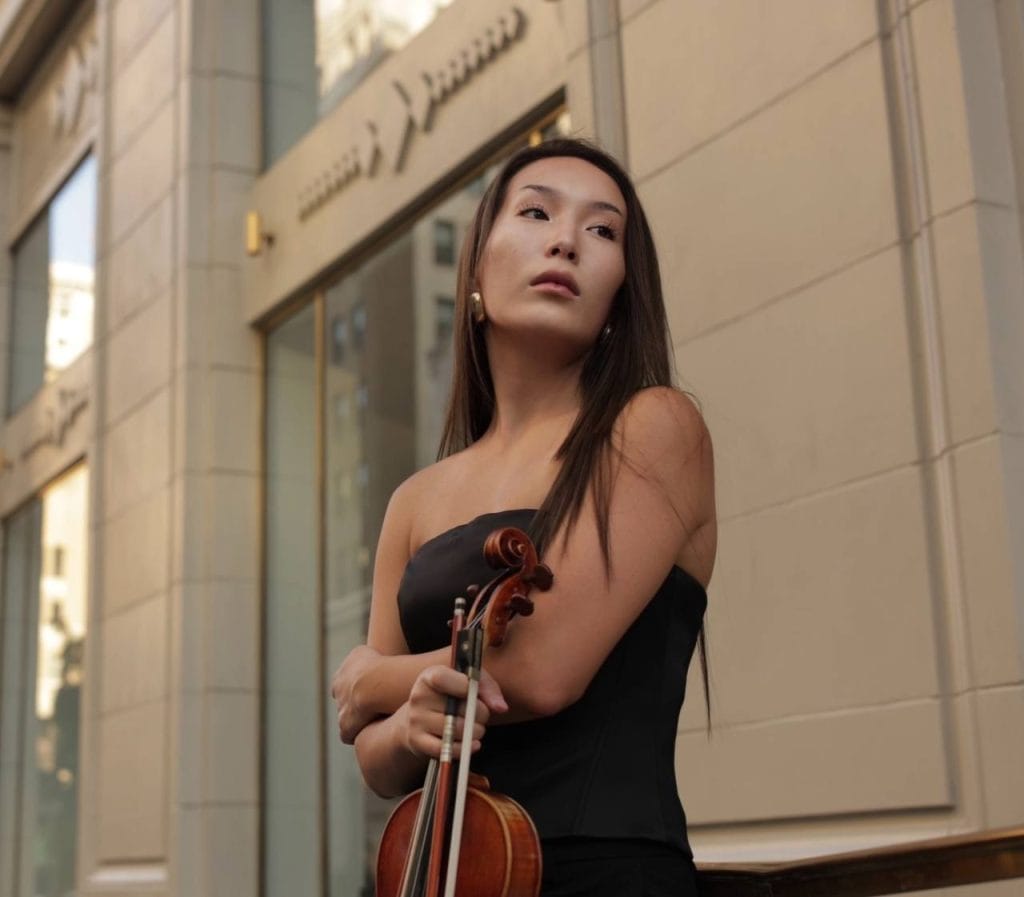
In February 2026, violinist Shynar Nagimova appeared on the stage of Carnegie Hall as part of a charity gala concert in New York, bringing Kazakh music to one of the world’s most iconic venues. The performance became both a cultural statement and a personal milestone – and the reason we’re telling her story now.
Some musicians play the violin. Shynar Nagimova lives it.
At the age of five, she picked up a violin. Not a toy – a real one. This childhood pastime set in motion a chain of events that would shape the fabric of her life – it would eventually lead from her hometown of Atyrau to Los Angeles, from childhood etudes to the stage of Carnegie Hall.
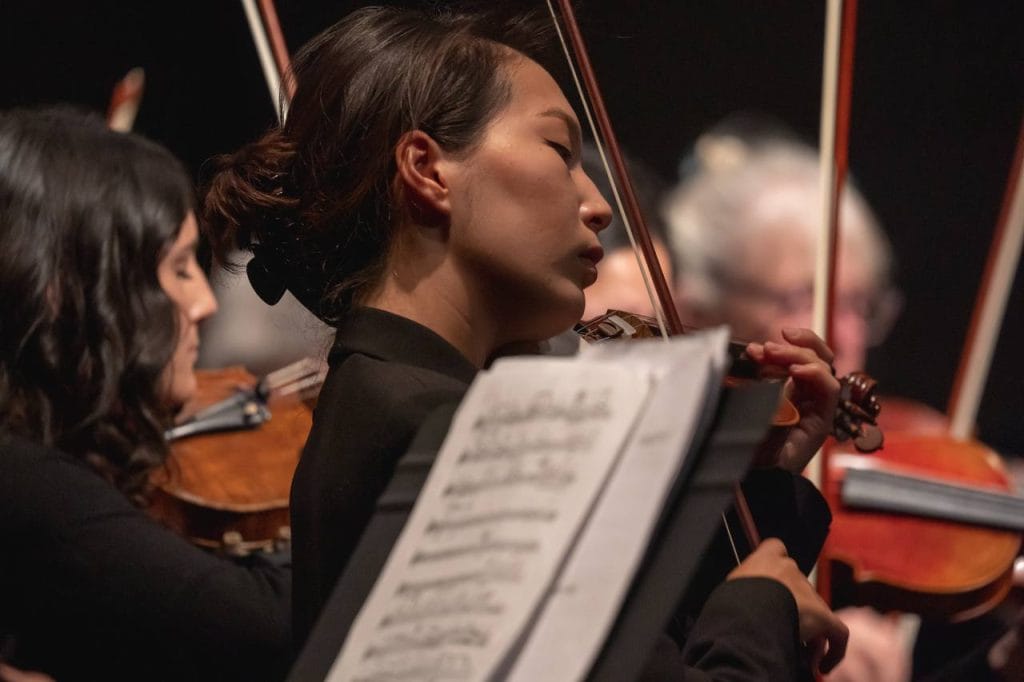
Today, Shynar serves as a violin teacher at the City of Los Angeles Department of Recreation and Parks and assists on a volunteer basis as an Assistant Principal Violin of the Santa Monica College Symphony Orchestra. But her story is not one of overnight success. It is built on discipline, cultural transition, doubt, resilience – and unwavering commitment to music.
Interview With Shynar Nagimova
When you look back at your earliest training, what habits from that period still shape how you practice today?
“The foundation I built as a child still defines me. Slow practice. Attention to intonation. Respect for structure. My first teacher, Klara Aitkalievna Nusuppaeva, was uncompromising about fundamentals. At the time, I didn’t fully understand why we repeated simple exercises for so long. Now I realize that discipline became my anchor.
Even today, before learning a new piece, I return to basics – scales, bow control, tone production. Those early habits prevent me from rushing. They remind me that growth is built quietly.”
You have competed and performed in several countries. How did adapting to different musical cultures change the way you approach interpretation?
“Competing in Vienna, Moscow, Spain – each place carried its own aesthetic expectations. In some traditions, emotional restraint is valued. In others, bold expression is encouraged.
Adapting didn’t mean changing who I was. It meant listening more carefully. I learned that interpretation is a dialogue between composer, performer, and cultural context. That awareness expanded my palette. I stopped thinking in terms of ‘right’ or ‘wrong’ and started thinking in terms of perspective.”
Her international achievements include winning such prestigious competitions as the CalASTA Los Angeles Solo Competition and, in December 2025, First Prize at the American Protégé International Music Talent Competition Fall 2025, which is widely recognized as one of the most inspiring platforms for musicians to showcase their talent on an international stage. The prize: a gala performance at Carnegie Hall, one of the most prestigious and inspiring concert venues in the world.
For that performance, she chose not a standard concerto but “Boz Aigyr” by Evgeny Brusilovsky – a Kazakh folk-based piece.
“It was my cultural statement,” she explains. “That stage became more than a career milestone. It became a bridge between my roots and my present.”
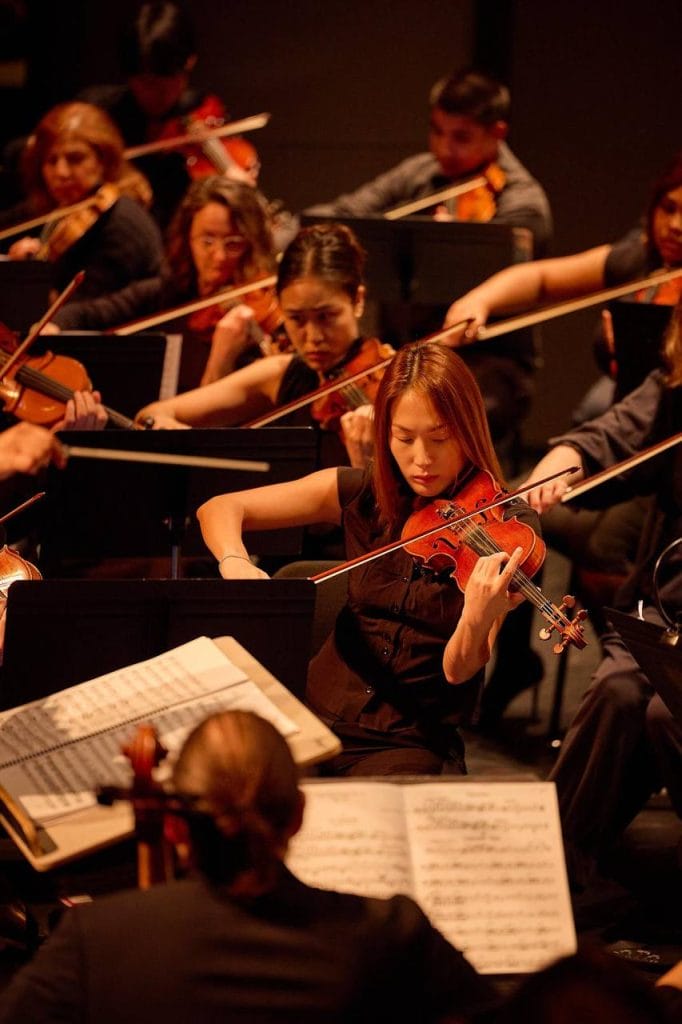
What did serving as Assistant Principal Violin teach you about leadership inside an orchestra section?
“Leadership in an orchestra is subtle. You don’t command – you guide. You breathe with the section. You anticipate the conductor’s intention and translate it physically.
I learned that authority comes from reliability. If your colleagues trust your preparation and your musical clarity, cohesion follows naturally. It’s less about ego and more about responsibility.”
Speaking of Shynar’s orchestral experience, it was greatly shaped during 2019-2022, when she performed with the Santa Monica College Symphony Orchestra. And as for her professional development, it includes masterclasses with Midori Goto, Christian Tetzlaff, James Ehnes, and Richard O’Neill. She also earned her Performing Arts degree from Santa Monica College.
Yet she is cautious about allowing tradition to become confinement.
How do you balance respecting a score with bringing personal decisions into phrasing and tone?
“A score is a map, not a cage. The composer gives us architecture – rhythm, harmony, and articulation. But within that structure, there is space for breath and nuance.
I study the historical context first. Only after understanding the language of the composer do I allow myself interpretive flexibility. Personal expression should grow organically from knowledge, not rebellion.”
Beyond the orchestra, she records studio projects, participates in public performances, and expands her presence in modern media formats. For her, classical music must live in the present.
Her continued involvement with the Santa Monica College Symphony Orchestra is on a volunteer basis, reflecting her commitment to the musical community while maintaining her primary professional role.
What role does physical conditioning play in maintaining consistency across demanding concert schedules?
“Physical strength is directly connected to mental resilience. Long rehearsals and performances require endurance – not only emotional but muscular.
I train regularly, dance high heels choreography, and hike difficult mountain trails. These activities build balance and stamina. When your body is stable, your sound becomes stable. Consistency on stage begins off stage.”
She brings this holistic mindset into her work as an educator. Shynar teaches violin at the City of Los Angeles Department of Recreation and Parks. Her philosophy is simple: No man is an island.
“Music is community,” she says. “But personal responsibility is equally important. Every student must own their development.”
Looking ahead, what kind of work would you like your next phase of performing and teaching to center on?
“I want to integrate tradition with contemporary platforms – orchestral work alongside media projects, competitions alongside community engagement.
My goal is growth without noise. No dramatic reinvention – just steady expansion. I want to create projects that make classical music accessible without simplifying it. And in teaching, I want to help students build both technical foundation and independent thinking.”
In an era when classical music is struggling to find a new language, Shynar already speaks it freely. Without fear of making mistakes. Without fear of being herself.
The post Violin Without Borders: Shynar Nagimova’s Journey from Childhood Etude to the Carnegie Hall Stage appeared first on Magnetic Magazine.