




All images sourced from company websites.
Whether we like it or not, AI is coming.
I completely understand the hesitation from most of the music industry on AI. Yes, it’s scary. At many points, it can steal from artists’ work without their consent. Let me make this clear: I do not condone usage of unethical AI in music production, or using AI as the entire music production process. What’s the point of making music if you’re just going to click a few buttons and get a sub-par finished production spat back out at you? The best part of music production is the journey, not the destination. Plus – it opens up the possibility of unconsenting parties having their work trained on, used, and released by others, and could even lead to lawsuits. We all saw the recent high-profile story involving a certain British singer; this should serve as a cautionary tale for the entire music production world.
With that being said, there are a ton of tools out there using AI both ethically and creatively, and today, we’ll be going through some of them. A lot of companies out there have realized that the journey of creating music is the best part, and have created some really great tools to help producers out there create at a higher level than before. Whether you’re looking to transform voices, separate stems, or do something else all together, there’s certainly an ethically-sourced AI-powered tool out there for you.
Today, we’re going to go through six companies doing AI correctly. By the end of this, hopefully you, too, will be able to see that AI is not simply a replacement for the creative process – it can be an essential part of it.
Table of Contents
LALAL.AI
AI has been used in stem splitting for years now – here’s a company that’s made it its main calling card.
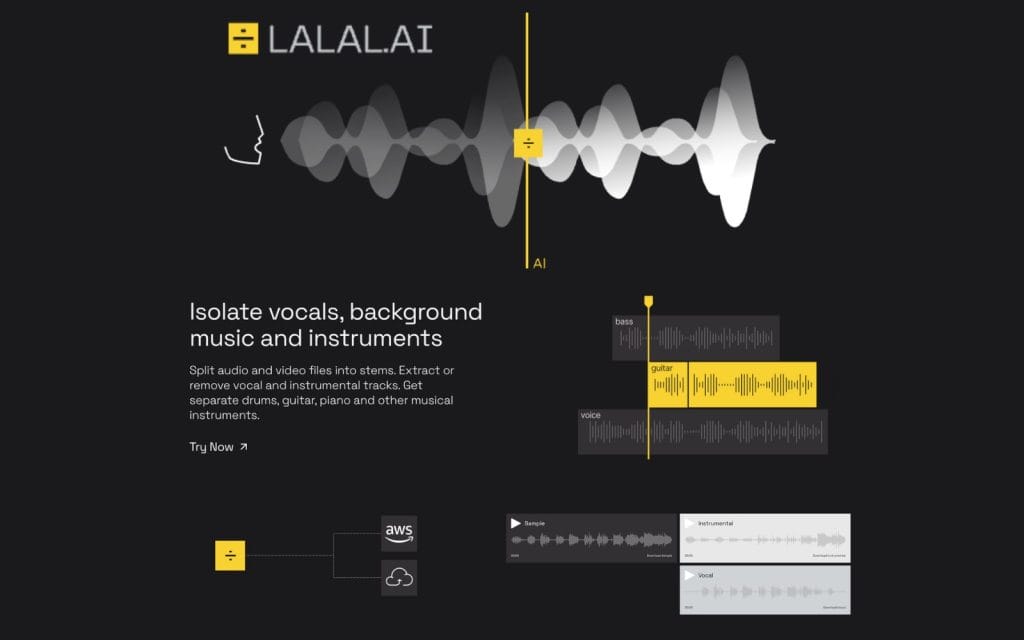
LALAL.AI has established itself as one of the most trusted AI audio platforms in music, combining fast, high-quality stem separation with emerging creative voice tools. Its core stem-splitting engine delivers clean, export-ready vocals, drums, bass, piano, guitars, and instrumentals with minimal artifacts, making it a reliable choice for producers, remixers, DJs, and editors who need precision rather than real-time shortcuts. Designed for offline processing, LALAL.AI prioritizes audio fidelity, producing files that drop seamlessly into professional DAWs and post-production workflows.
Beyond stems, the platform’s AI Voice Cloner expands creative and practical possibilities, allowing users to replicate vocal timbre for demos, backing vocals, harmonies, localization, or experimental sound design – and, thankfully, it’s all sourced ethically. The web-based interface keeps the process simple (upload, process, download) while batch tools and API access support large-scale catalog work. By pairing studio-grade stem extraction with flexible voice cloning technology, LALAL.AI positions itself as a powerful, production-ready AI toolkit for today’s music creators.
Auphonic
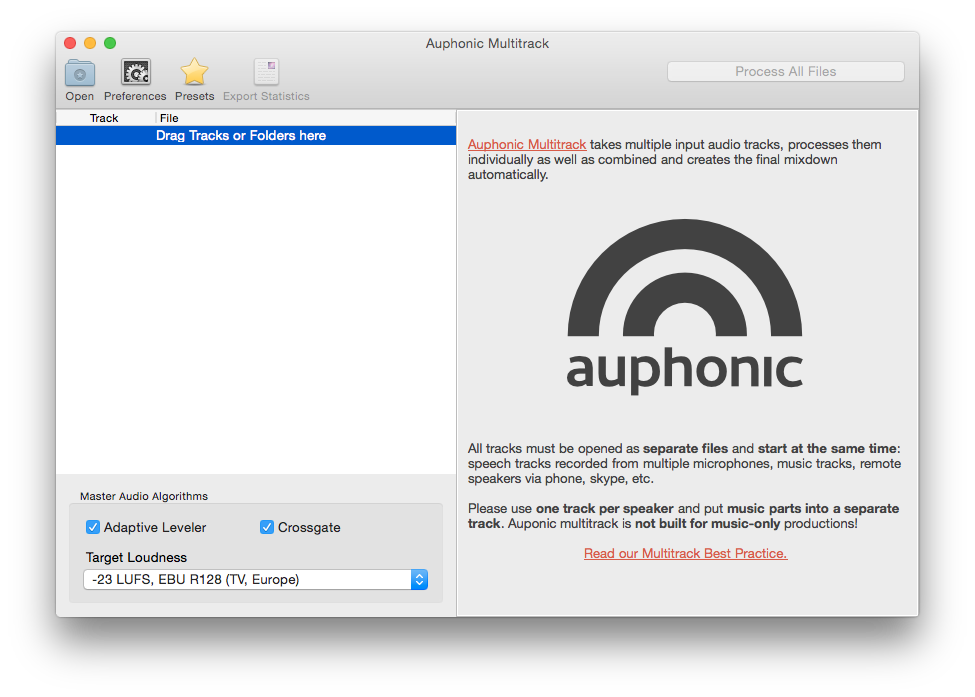
Auphonic is a professional audio post-production platform designed to make spoken-word and music content sound consistent, polished, and ready for broadcast with minimal manual intervention.
Trusted by podcasters, radio producers, musicians, and video creators, Auphonic uses intelligent algorithms to automatically level loudness, reduce noise and hum, correct EQ imbalances, and manage dynamics without overprocessing the source. Its standout strength is reliable loudness normalization to industry standards, ensuring mixes translate cleanly across streaming platforms, broadcast, and video delivery.
Auphonic works seamlessly via web app, desktop tools, mobile apps, and API access, making it easy to process single files or entire catalogs at scale. Multitrack support allows voices, music, and ambience to be balanced intelligently, while format exports and metadata handling streamline distribution. By removing technical friction from audio finishing, Auphonic lets creators focus on content, and lets them be confident that the final sound will be clean, compliant, and professional.
Soundlabs.ai
We’re big fans of legendary producer BT’s newest venture.
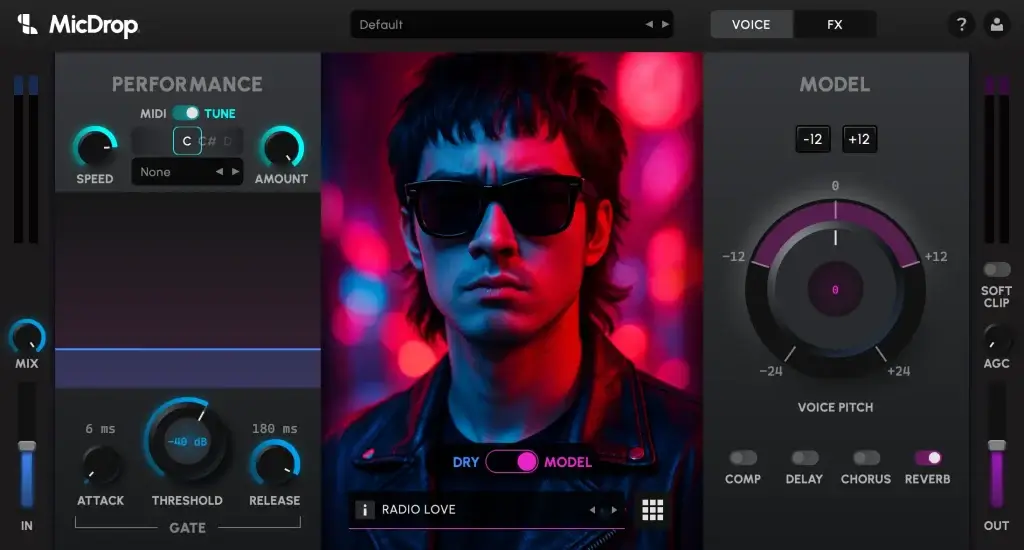
Soundlabs.ai is the creator of Micdrop, an AI audio platform focused on voice creation, transformation, and performance-ready vocal tools for modern creators. Built with musicians, producers, and content teams in mind, it allows users to generate, modify, and perform with AI voices in real time or offline, opening new possibilities for songwriting, demos, covers, and experimental production. The plugin’s voice models are designed to capture tone, articulation, and expression rather than flat delivery, making them suitable for melodic and musical use. You can use it to turn your voice into a rock singer, a choir, a robot, or anything else your heart desires – regardless of how muddy the source material is.
Soundlabs.ai also emphasizes ethical voice modeling, with opt-in voice creators and licensed voice packs that address concerns around consent and ownership. Micrdrop’s client-side workflow (made possible by Apple Silicon and other high-grade computer chips) supports fast iteration, allowing creators to audition ideas, harmonies, or alternate vocal performances instantly. With more launches on the horizon, Soundlabs.ai has positioned itself as a flexible, forward-facing company built for the evolving relationship between AI and human creativity.
Dreamtonics
We’ve just talked about an ethical voice manipulator. Now, here’s the maker of an ethical voice creator.
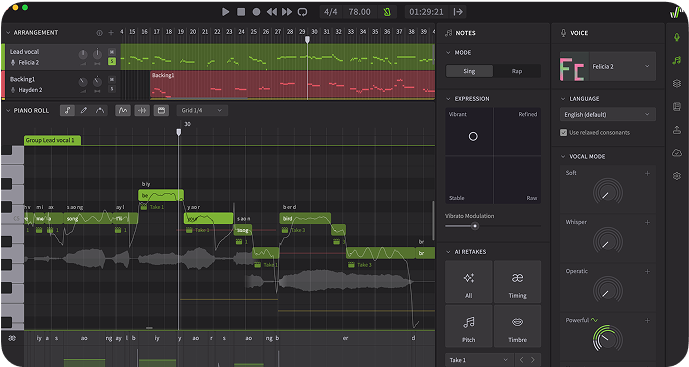
Dreamtonics is best known for Synthesizer V, an AI vocal synthesis platform built specifically for music creators who need expressive, controllable singing voices rather than generic speech output. Unlike text-to-speech tools, Dreamtonics focuses on pitch accuracy, phrasing, dynamics, and emotional nuance, allowing producers to shape performances at a musical level. Notes, lyrics, vibrato, timing, and expression can be edited directly within a piano-roll-style interface, making the workflow familiar to anyone used to DAWs or MIDI programming. High-quality voice databases (developed with real vocalists) deliver natural tone and clarity across genres, from pop and electronic to cinematic and experimental music.
Dreamtonics’ AI engine excels at realistic transitions, legato phrasing, and expressive dynamics, reducing the mechanical feel often associated with synthetic vocals. Used for demos, songwriting, backing vocals, and even final productions, Synthesizer V has become a powerful creative instrument in its own right. For artists exploring AI as a compositional and performance tool, Dreamtonics offers one of the most musically sophisticated vocal platforms available – and there’s so much more beyond that plugin (go check out Vocoflex, too!).
Acon Digital
One of our favorite post-processing companies out there, Acon Digital is a respected audio software developer known for combining advanced AI-driven processing with transparent, professional-grade sound tools.
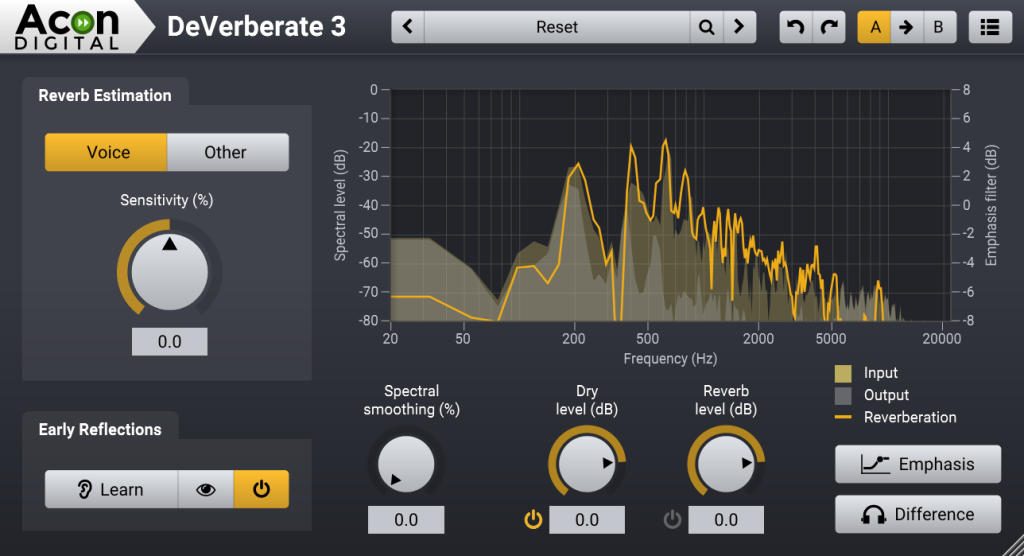
Widely used across music production, post-production, and broadcast, its software focuses on solving complex audio problems with accuracy rather than coloration. Acon Digital’s AI-powered restoration technologies, most notably in DeVerberate, DeNoise, and Acoustica, use machine learning models trained to separate signal from noise, reverb, and artifacts while preserving the natural character of the source. This makes them especially effective for dialogue cleanup, archival restoration, and challenging recordings.
Beyond restoration, Acon Digital also develops creative effects and mastering tools that benefit from intelligent analysis, delivering clean EQ, dynamics, and spatial processing with minimal CPU load. Features like spectral editing, multichannel support, and ARA integration further embed these tools into modern professional workflows. By applying AI where it meaningfully improves results, without sacrificing control or transparency, Acon Digital offers a refined, production-ready approach to intelligent audio processing.
Hit’n’Mix
Lastly, let’s talk about a full-on AI DAW.
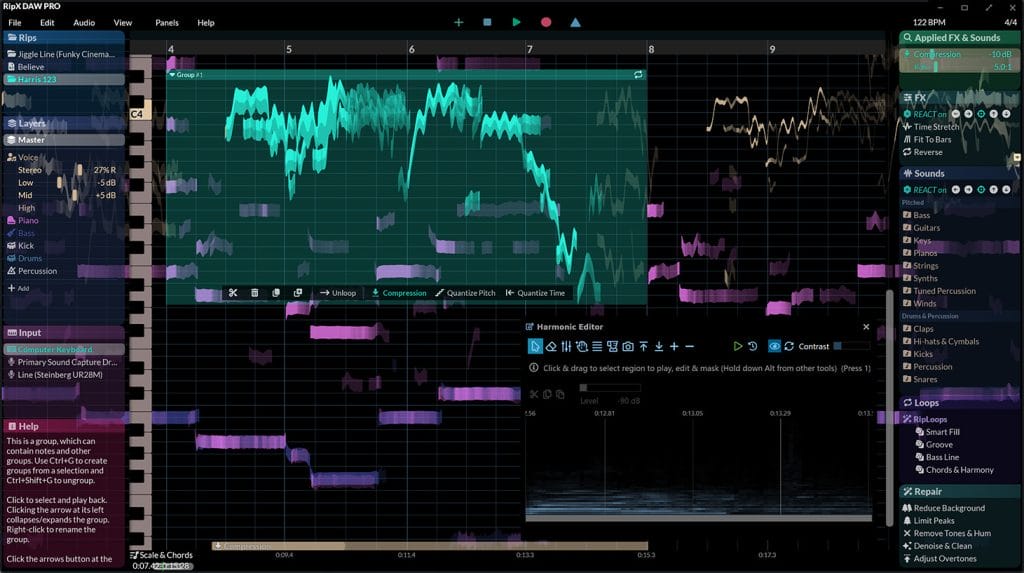
Hit’n’Mix’s flagship program is RipX, an AI-powered audio platform that redefines how music can be deconstructed, edited, and reimagined. Built around advanced machine-learning separation technology, Hit’n’Mix allows users to break full mixes into individual components (vocals, drums, bass, and instruments) then edit them at a microscopic level. Unlike conventional stem tools, RipX lets creators manipulate pitch, timing, formants, and even individual notes within polyphonic audio, blurring the line between audio and MIDI-style control. This makes it especially powerful for remixing, restoration, sound design, and creative experimentation.
The platform’s AI engine continuously analyzes harmonic and rhythmic structure, enabling edits that would be impossible in standard DAWs without re-recording. Used by producers, educators, and audio engineers alike, Hit’n’Mix prioritizes depth and flexibility over one-click shortcuts. There’s also a virtual reality version that allows you to physically dive deeper into the music you’re creating. By applying AI to unlock detailed, non-destructive control over recorded music, Hit’n’Mix offers one of the most forward-thinking approaches to intelligent audio editing available today.
FAQ About AI & Music Production
Is AI in music production a new phenomenon?
Machine learning was present in music production tools far before the “dawn of the AI age”. It’s obviously seeing a lot of advances & discussion right now, but this is not a new phenomenon whatsoever.
Is AI a threat to music producers?
I’ve been producing for close to 10 years and have been obsessed with music even longer. The best part about music is the innately human part of it – when you can tell that someone put all of themselves into a song or an album. Machine learning can do its best, but it will never fully re-create that sense of passion that you can hear in certain projects.
I think it’s a threat to producers who are only in it for the money & don’t care about what they’re making. But for true artists who ooze blood, sweat, and tears over their work? I think you’ll be fine. And, besides, all the companies above will help you step into the brave new world – none of them should be seen as a “threat”.
Can AI make a full song?
There are programs out there that do that. I didn’t include any on this list. Use AI as a tool in the creative process, not as the full process.
What is the 30% rule?
AI should handle no more than 30% of a task. Humans should take care of the other 70% (or more). This is always a good rule to live by.
Are streaming platforms banning AI music?
This is a hot topic right now. Bandcamp and Spotify have both made statements saying they’ll remove music that’s AI generated, but there’s really no indicator of a.) how they judge if a song is AI and b.) how much AI is okay in a song. My best guess is that they’ll remove the blatant AI slop – if you’re using one of these tools above the way that they are intended, I’m sure you won’t be in trouble.
The post 6 Companies Combining AI & Music Production The Right Way in 2026 appeared first on Magnetic Magazine.