





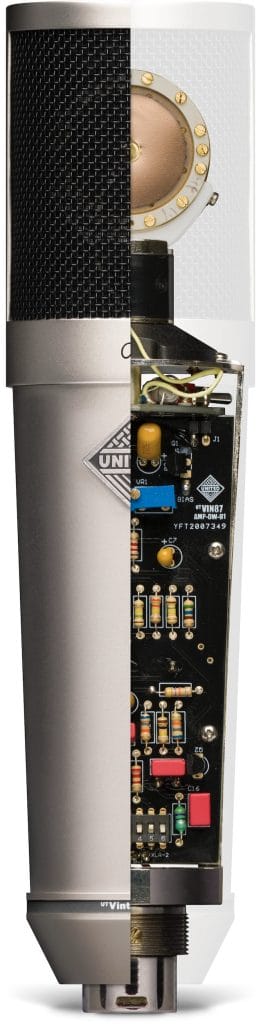
Certain microphones earn their reputation by simply working, day after day, across countless sessions, voices, and rooms. The UT Vintage87 from United Studio Technologies was designed with that exact expectation in mind. Announced this week, the UT Vintage87 takes the sonic foundation of United’s acclaimed Twin87 and distills it into a fixed-cardioid microphone built for speed, consistency, and accessibility.
Rather than chasing novelty or overloading the design with options, United focused on refining the essentials. The result is a large-diaphragm condenser that delivers the balanced, familiar tone engineers associate with classic ’87-style microphones, while removing features that many modern users rarely touch. One pattern, one sound, and fewer decisions standing between setup and recording.
According to United co-founder Chad Kelly, the goal was clarity. The UT Vintage87 uses the same internal components as the Twin87, with the savings coming from a streamlined feature set rather than downgraded parts. For working studios, home engineers, and creators who want reliable results without constant tweaking, that approach makes practical sense.
This Thing Is Built Like a Studio Tool
At the core of the UT Vintage87 is United’s custom UT-K87 capsule, a dual-diaphragm, K87-style design machined from brass and finished with a 24k gold-sputtered membrane. Each capsule is assembled in a clean-room environment using 6-micron Japanese PET film, delivering consistency across units and sessions. The goal here is stability, not coloration tricks, which matters when a microphone becomes part of a daily workflow.
Supporting the capsule is a custom-wound, US-made output transformer developed specifically for this platform. Drawing inspiration from early German transformer designs, United rebuilt the concept with fewer physical limitations. By using all-nickel laminations and significantly increasing metal mass, the transformer offers strong headroom and a low-frequency response that stays intact even on long cable runs. That translates into recordings that feel controlled and open without leaning on corrective processing later.
The circuit continues that no-shortcuts philosophy. Premium capacitors, tight-tolerance resistors, and carefully selected transistors appear throughout, choices more commonly associated with higher-priced microphones. United also added a switchable RF filter, a practical inclusion for modern studios dealing with increasingly crowded electromagnetic environments.
By removing pattern selection circuitry, the UT Vintage87 achieves a slightly hotter and cleaner cardioid response than traditional multi-pattern designs. Fewer internal pathways mean a more direct signal and improved signal-to-noise performance, which benefits vocals, voice-over, acoustic instruments, and dialogue recording equally well.
United UT Vintage87 Is A Microphone Designed for Momentum
The UT Vintage87 is not positioned as a collector’s piece or a novelty reissue. It is designed to be used, moved, and trusted. For engineers who want a dependable first choice, and for artists building their sound without relying on rented gear or inflated budgets, it fills a practical gap.
Shipping begins in Q1 2026 with a US MAP of $399, placing it firmly within reach of serious creators who value results over mythology. By focusing on execution rather than nostalgia, United has delivered a microphone that fits into modern studios while honoring the sonic expectations that made the original format so widely adopted.
The post United UT Vintage87 Delivers Classic Studio Tone at a Working Price appeared first on Magnetic Magazine.